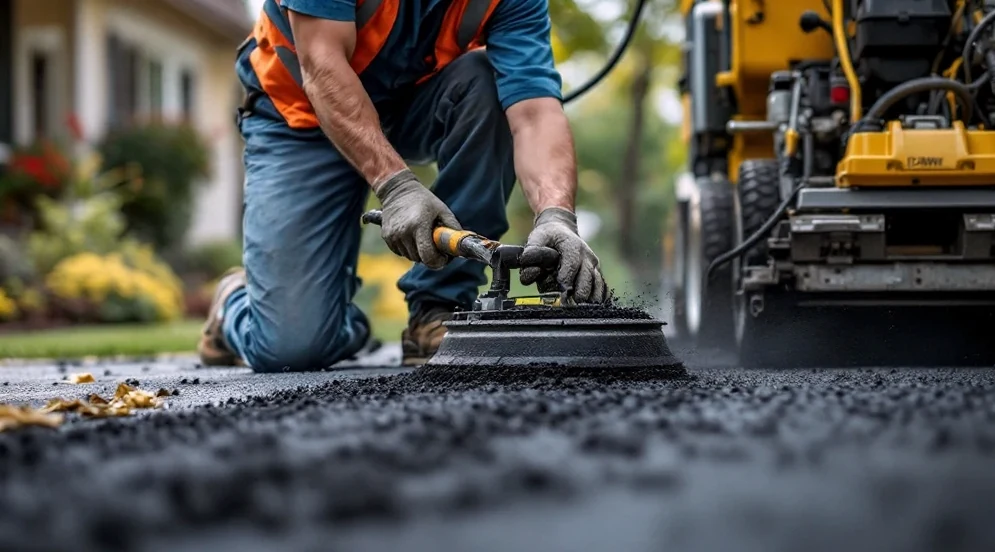
How does Asphalt Paving work?
We excavate the existing surface, compact a crushed-stone base, then lay hot asphalt in lifts and roll it tight while it is still hot. The asphalt mix leaves the plant around 300 degrees and has to be placed and compacted before it cools, so the whole job is a race against temperature.
Asphalt is aggregate, sand, and liquid asphalt binder mixed hot at a plant, trucked to your driveway, and spread before it stiffens. In Huntsville, mix comes out of plants around the Tennessee Valley, and in summer the window between the plant and your driveway is short. If a load sits too long, the mat goes down cold and never knits together the way it should. That is why you will see us tarp the truck bed and move fast once we start.
<p>Under the asphalt is the part you never see and the part that decides whether your driveway lasts fifteen years or thirty. Crushed stone base, compacted in lifts, sheds water and carries the load. Asphalt is flexible, so it moves with the ground, but it needs something solid underneath. Leave out the base and you get ruts, alligator cracking, and puddles within a couple of seasons.</p>
North Alabama soil is a mix of red clay and, in places, limestone. Clay holds water and swells when it is wet, then shrinks when it dries. That movement is hard on any pavement. A thick, well-compacted base and correct slope are how we deal with it. Water is the enemy, not traffic. A driveway that drains properly will outlast one that gets driven on twice as much but holds water.
Asphalt also comes in different mixes. A surface course is finer and smoother; a binder course is coarser and goes underneath. For residential driveways we usually place one or two lifts depending on thickness. Thickness matters: two inches of compacted asphalt over six inches of base is a common residential spec, and going thicker costs more but holds up better under heavy trucks or a steep slope.
Short version
- Asphalt is placed hot and must be rolled before it cools, usually within minutes.
- Stone base and slope do more for longevity than asphalt thickness alone.
- Clay soil and poor drainage are the two biggest reasons driveways fail early here.
- Most residential jobs are done in one or two days once the base is ready.
What to expect, start to finish
A typical asphalt driveway job runs through six stages: measure and quote, mark utilities, tear out or prep, build and compact the base, lay and roll the asphalt, then clean up and let it cure. You will be without a usable driveway for at least a day, sometimes two, and you should not park on it for several days after.
Before anyone digs, we call 811 to have utilities marked. That is free and required. Gas, water, fiber, and electric lines run under a lot of Huntsville yards, and a shovel through a gas line is a bad afternoon. The marks fade after a couple of weeks, so we schedule the dig close to the mark date.
Tear-out comes next if there is old pavement. We break it up, load it, and haul it off. If the old driveway is sound and just worn, sometimes we can overlay it, but only if the base underneath is still good and the surface is not too far gone. Overlaying a cracked, settled driveway just transfers the cracks up through the new layer within a year or two. We would rather tell you that up front than take your money for a patch that will not hold.
<p>Then the base. We grade the subgrade so water runs away from the house and garage, then bring in crushed stone and compact it in lifts, usually two to four inches at a time. A plate compactor or roller goes over each lift. This is the slow part, and the part a rushed crew will cut short. You can usually tell within a season whether the base was done right: if it was not, the asphalt starts to dip and crack at the edges.</p>
Asphalt day is fast and loud. The paver lays a mat, workers rake the edges by hand, and a roller goes over it while it is hot. Edges get tamped and often a small amount of extra mix is feathered where the driveway meets the street or garage apron. We keep an eye on the thermometer, because if the mix drops below a certain temperature it will not compact properly and the surface will be porous.
After the roller stops, the driveway needs to cool. In summer that can be a few hours; in cooler weather it takes longer. You can usually walk on it the same evening, but keep cars off it for at least three days and heavy trucks off for a week or more. In hot weather, tires can leave marks for the first few weeks, so park in the same spot and avoid turning the wheels while stationary.
- Measure and quote.We walk the driveway, check slope and drainage, and give you a written number. No deposit until you approve.
- Mark utilities.811 comes out and flags gas, water, electric, and fiber. Free, and it takes a few days to schedule.
- Tear out or prep.Old asphalt is broken up and hauled away, or the existing surface is cleaned and prepped for overlay if it qualifies.
- Build the base.Crushed stone is placed and compacted in lifts, with the grade sloped to drain away from the house.
- Lay and roll asphalt.Hot mix is placed, raked, and compacted before it cools. Edges are tamped by hand.
- Clean up and cure.We sweep, haul off debris, and tell you when you can park on it. Usually three days for cars.
How long does Asphalt Paving take?
Most residential driveways take one to three days of on-site work, but the calendar time from first call to finished driveway is usually one to three weeks because of utility marking, scheduling, and weather. Asphalt cannot be placed in heavy rain or on saturated ground, so a wet stretch in spring can push everything back.
The on-site work breaks down like this: tear-out and hauling usually take half a day to a full day depending on size and access. Base prep takes another half day to a day. Asphalt placement is typically a few hours, and cleanup is quick. A straightforward driveway can be done in a single long day if the base is already in good shape and the truck can back right up to the work area.
Access changes everything. A wide, open driveway where the paver and the dump truck can pull in and turn around moves fast. A narrow driveway between a house and a fence, or one with a low tree canopy, means the crew hauls material by hand or with a small power buggy. That can add hours. If your driveway is on a steep slope, we may need to place the asphalt in a way that keeps the paver from sliding, which also slows things down.
<p>Weather is the wild card in Huntsville. Spring brings thunderstorms and saturated clay that will not compact. Summer heat helps asphalt cure, but afternoon storms can shut a job down mid-placement. Late fall and winter are workable as long as the ground is not frozen and the plant is running, but mix plants sometimes close for the season, so late-season jobs can be harder to schedule. If you want a new driveway before summer, call in late winter or early spring.</p>
After the asphalt is down, the driveway keeps changing for a few weeks. It darkens and hardens as it cures. You may see a slight sheen or smell the asphalt for a day or two. Small surface marks from the roller are normal and fade. If you notice a soft spot or a puddle forming within the first month, call us. That is usually a drainage or base issue we can address before it becomes a bigger repair.
Day 1
Tear-out, hauling, and rough grading. The driveway is torn up and not usable.
Day 2
Base stone placed and compacted, final grade set. Still not usable.
Day 3
Asphalt placed and rolled. Walkable by evening, no parking yet.
Days 4 to 7
Cure time. Cars can usually park after about three days; keep heavy trucks off longer.
Weeks 2 to 4
Surface hardens and darkens. Minor roller marks fade. Watch for any soft spots or puddles.
What asphalt paving costs in Huntsville
The average cost to pave a driveway is $4,897, but most asphalt driveway projects in Huntsville fall between $2,112 and $6,336, with a typical estimate around $3,696. (angi.com) (projectcostatlas.com) (projectcostatlas.com) Those numbers move with size, base work, access, and whether there is old pavement to tear out.
Size is the biggest driver. A single-car driveway of a few hundred square feet sits at the low end; a long, wide driveway serving a three-car garage pushes toward the top of the range and beyond. Base work adds cost when the existing subgrade is soft or the grade needs to change to fix drainage. Tear-out and hauling add cost because it is labor and dump fees. A steep slope or tight access adds labor. If you are comparing quotes, make sure each one spells out thickness, base depth, and whether hauling is included.
We give a written quote after walking the property. The number you get from a phone call is a guess; the number you get after we see the slope, the soil, and the access is the one that holds. If a quote comes in far below the others, ask what is missing. Often it is base depth, compaction, or hauling. Those are the parts you cannot see and the parts that decide how long the driveway lasts.
Financing and timing can soften the hit. Some homeowners phase the work: do the main driveway now and a parking pad later. That can make sense if budget is tight, but doing it all at once usually costs less per square foot because the crew and equipment are already on site. If you are planning a new build, paving after the heavy construction traffic is done saves you from repairing a driveway that got chewed up by a concrete truck.
Worth it when
- Your base is failing, and patching it has become a yearly habit.
- Drainage runs toward the house or garage.
- You want a surface that lasts twenty years with basic care.
- You are selling and curb appeal matters.
Hold off when
- Heavy construction traffic is still coming through.
- Ground is saturated and will not compact.
- You only need a small crack filled, which is a repair, not a repave.
- Your budget is tight and a sealcoat would buy you a few more years.
What most homeowners get wrong
The most common mistake is judging a quote by price alone. A cheap job usually skimps on base depth or compaction, and that shows up as cracks and ruts within a couple of years. The second is paving over a drainage problem instead of fixing it, which just moves the water somewhere else.
Another frequent miss is parking on the new driveway too soon. Asphalt is still curing for days after it is cool enough to walk on. Parking a car on it the same day can leave ruts that never come out. Wait at least three days for cars, longer in hot weather, and keep heavy trucks off for a week or more. If you have to park somewhere, park on the street.
People also underestimate how much water matters. A driveway that slopes toward the garage will send water under the slab and into the foundation. We fix that with grade, not with a sealer. If your current driveway puddles against the house, that is a sign the base or the slope is wrong, and a new surface on top will not solve it. Sometimes the fix is a swale or a drain, and we will tell you that before we quote the asphalt.
Finally, homeowners often leave the sealcoat off the list. Asphalt is porous, and over time the binder oxidizes and the surface gets gray and brittle. A sealcoat every two to three years slows that down and keeps water out. It is not a cure for structural cracks, but it is the cheapest way to extend the life of a driveway you already have. We usually recommend waiting at least six months after a new install before the first sealcoat so the asphalt has time to cure.
Hairline cracks
Normal as asphalt ages. Keep an eye on them and seal before water gets in.
Alligator cracking
A sign the base is failing. Patching helps short term, but the base needs attention.
Puddles against the house
Water is getting to the foundation. Fix the grade before it causes bigger problems.
Frequently Asked Questions
How long before I can drive on a new asphalt driveway?
You can usually walk on it the same evening, but keep cars off for at least three days. In hot weather, wait longer and avoid turning the wheels while the car is stationary, because the surface is still soft. Heavy trucks should stay off for a week or more. If you have to park somewhere in the meantime, use the street.
How thick should asphalt be for a driveway?
For most residential driveways in Huntsville, two inches of compacted asphalt over four to six inches of compacted crushed stone is a solid spec. If you park heavy trucks or the slope is steep, going thicker helps. Thickness is one of the first things a low quote cuts, so ask for it in writing.
Can you pave over my existing asphalt driveway?
Sometimes. If the old driveway is sound, not too cracked, and the base underneath is still good, an overlay can work and costs less than a full tear-out. If the base has failed or there is significant settling, an overlay just transfers the problem up. We will tell you which one you are looking at after we see it.
How long does a new asphalt driveway last?
A well-built driveway with a good base and proper drainage can last twenty years or more. The variables are base quality, drainage, how heavy the traffic is, and whether you sealcoat every few years. Driveways that fail early almost always have a base or drainage problem, not an asphalt problem.
Do I need to sealcoat a new asphalt driveway?
Not right away. Wait at least six months so the asphalt has time to cure, then sealcoat every two to three years. Sealcoat slows oxidation and keeps water out of the surface. It will not fix structural cracks or a failing base, so if you see those, address them first.
What time of year is best for asphalt paving in Huntsville?
Late spring through early fall is ideal because the mix stays hot and the ground is workable. Summer heat helps compaction. Spring rain and saturated clay can delay a job, and winter can be hit or miss depending on whether the plant is running and the ground is frozen. If you want it done before summer, call in late winter.
Will asphalt paving smell?
You will notice an asphalt smell for a day or two after placement, especially in warm weather. It fades as the surface cures. It is not harmful at the levels you get from a driveway, but keep windows closed on the side of the house nearest the work if the smell bothers you.
What causes cracks in asphalt driveways?
Water and ground movement cause most cracks. Clay soil swells and shrinks with moisture, and if the base is not thick or well-compacted, that movement shows up as cracks in the surface. Tree roots, heavy loads, and poor drainage all make it worse. Hairline cracks are normal over time; wide or alligator cracks mean the base needs attention.
How much does asphalt paving cost in Huntsville?
The average cost to pave a driveway is $4,897, and most asphalt driveway projects in Huntsville fall between $2,112 and $6,336, with a typical estimate around $3,696. (angi.com) (projectcostatlas.com) (projectcostatlas.com) Size, base work, access, and tear-out move the number. The only way to get an exact figure is a free on-site quote.
Do you need to remove my old driveway first?
Not always. If the old surface is sound and the base is still good, an overlay can save money. If it is cracked, settled, or the base has failed, we tear it out and rebuild. Leaving a failed base in place just means the new asphalt inherits the same problems, usually within a year or two.
Sources
Need asphalt paving in Huntsville? Get a free estimate today.
📞 256-472-9731