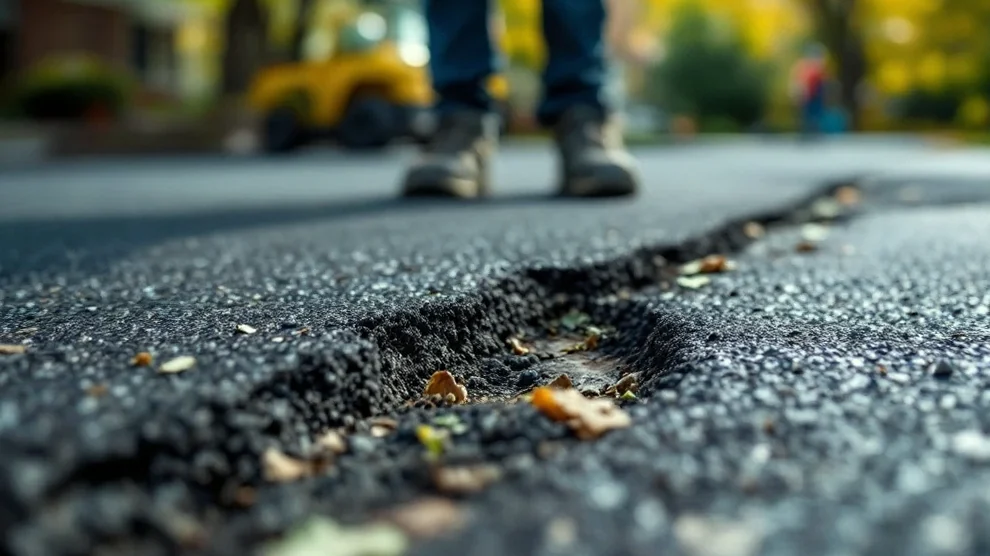
What are the signs you need Asphalt Paving?
You need asphalt paving when the damage has moved past the surface. Cracks wider than a pencil, alligator cracking, sunken spots, ruts, and potholes all mean the base under the asphalt has failed. Sealcoating and patching buy time on small issues, but base failure calls for milling or full replacement.
Homeowners around Jones Valley and Monte Sano call us about a crack and end up talking about a new driveway. That jump is not a sales pitch. It is what happens when water gets under the asphalt and softens the crushed stone base. Once that base moves, the asphalt on top has nothing solid to sit on, and no amount of crack filler fixes it.
Surface problems and structural problems look similar from the driver's seat but behave nothing alike. A hairline crack from a dry summer is a maintenance item. A crack that has widened, spread into a spiderweb, or started dropping one side lower than the other is the asphalt telling you the layers underneath have shifted.
Age alone is not the trigger. A well-built driveway on good drainage can run 15 to 20 years before it needs replacement. A poorly drained one on expansive clay can start failing in five. What matters is the condition, not the birthday.
Short version
- Cracks wider than a pencil, or cracks that have spread into a web, mean base failure, not a surface issue.
- Dips, ruts, and potholes that return after patching point to water sitting under the asphalt.
- Sealcoating protects sound asphalt. It cannot rescue asphalt that has already broken up.
Warning signs to watch for
Walk your driveway after a rain and look for standing water, then check the edges and the center for cracks, dips, and loose aggregate. The signs that matter most are the ones that come back after you fix them, because that means the problem is underneath, not on top.
Alligator cracking is the clearest signal. It looks like reptile skin, a patch of interlocking cracks with no single direction. That pattern shows the base has lost its load-bearing capacity, usually from water or from a subgrade that was never compacted properly. Patching alligator cracking is throwing money at a symptom.
Potholes that reappear in the same spot within a season are another one. We fill a pothole properly and it stays filled. If yours keeps opening up, water is still getting in and pumping the fines out from under the asphalt every time a car rolls over it.
Edge cracking along the sides of the driveway, especially where it meets grass or a concrete apron, tells you the asphalt is drying out and shrinking or the shoulder was never supported. Depressions at the garage apron or where tires track are ruts, and ruts mean the mix is deforming under heat and load.
Crushed or raveling aggregate at the surface, where you can see loose stones and the texture has gone rough and pebbly, means the binder has aged out. That is a surface problem until it goes deep enough to expose the base, and then it becomes structural.
- Alligator cracking: interlocking cracks in a web pattern, base has failed
- Recurring potholes in the same spot: water is still getting under the asphalt
- Edge cracking and crumbling shoulders: unsupported edges drying out
- Ruts and dips in the wheel paths: the mix is deforming under heat and load
- Raveling and loose stones: the binder has aged out and the surface is breaking down
- Standing water after rain: drainage is wrong and the base is soaking
Hairline cracks, minor raveling
Clean and fill the cracks, then sealcoat within a season. This is maintenance, not replacement.
Widening cracks, edge crumbling, ruts forming
Water is getting in. Schedule an assessment before the next freeze-thaw cycle widens everything.
Alligator cracking, recurring potholes, sunken sections
The base has failed. Patching will not hold. Plan for milling and repaving or full replacement.
What causes these problems in Huntsville
Huntsville sits on expansive clay soil that swells when wet and shrinks when dry, and our summers push surface temperatures high enough to soften asphalt. Add heavy spring rain and the freeze-thaw swings we get in January and February, and you have a climate that works against pavement from both above and below.
That clay is the big one. Madison County soil holds water and moves with it. When the ground under a driveway swells after a wet spring, it pushes the asphalt up in places. When it shrinks in a dry August, it leaves voids. The asphalt bridges those voids for a while, then cracks. This is why driveways on the same street can fail at wildly different ages. It depends on how the lot drains and how the base was built.
Summer heat is the other half. Asphalt is a viscoelastic material, meaning it stiffens in cold and softens in heat. On a 95-degree July afternoon, the surface of a black driveway can get hot enough that a loaded truck or a trailer parked in one spot will leave a rut. That rut does not spring back. It stays.
Water is what turns a small problem into a big one. Every crack is a channel. Rain runs in, sits on the base, and softens it. Then traffic pumps the asphalt up and down, which pushes the fine particles out and makes the void bigger. That cycle is why a crack that looks minor in April can be a pothole by October.
Freeze-thaw does the rest. North Alabama gets enough hard freezes to matter. Water in a crack expands when it freezes and pries the crack wider. A few winters of that and a hairline crack becomes a structural break.
Spring
Heavy rain saturates the clay base. This is when new cracks show up and existing ones get worse.
Summer
Heat softens the asphalt. Watch for ruts under parked trailers and in the wheel paths.
Fall
Best window to pave or seal. Temperatures are workable and the ground is usually dry.
Winter
Freeze-thaw cycles widen every crack. Water that got in during fall does its damage now.
What happens if you ignore the signs
Ignoring early signs does not save money. It moves the repair from a maintenance line item to a replacement one. A crack you fill this fall is a few hundred dollars. The same crack left two winters becomes a failed section that has to be milled out and repaved, and that costs several times more.
The mechanism is straightforward. Water gets in through the crack, softens the base, and traffic pumps the asphalt. Each cycle makes the void under the surface bigger. The surface starts to dip. Then it breaks. By the time you see a pothole, the base under it is already gone, and filling the hole without fixing the base means it will open again.
There is also a safety side that homeowners tend to underestimate. A driveway with a two-inch lip at the garage apron will catch a low-clearance car. A sunken section that holds water will ice over in a Huntsville cold snap and stay icy longer than the rest of the driveway. Loose aggregate on a slope makes a slick surface for anyone walking down in the rain.
The cost curve is not linear. Catching it at the crack stage is the cheapest point. Catching it at the alligator stage means milling and repaving that section. Catching it after the base has failed across the whole driveway means full removal and rebuild, which is the most expensive outcome and the one most avoidable.
One more thing homeowners miss: a failing driveway affects drainage for the whole lot. Water that used to sheet off the asphalt now pools against the foundation or runs toward the garage. That is a landscaping and foundation problem on top of a paving problem, and it is much harder to fix once the water has been finding its way in for a few seasons.
First season
Hairline cracks appear. Water starts getting in. Filling them now is quick and cheap.
Year two
Cracks widen and spread. Base starts softening under the edges. Patching still works on isolated spots.
Year three to five
Alligator cracking and potholes show up. Sections need milling and repaving, not patching.
Beyond that
Base failure across the driveway. Full removal and rebuild is the only fix that holds.
What to do when you spot the signs
Get eyes on it before you spend anything. Walk the driveway after a rain, note where water stands and where cracks have widened since last year, and take photos with something for scale. That record tells a paving crew more in five minutes than a phone description can.
If the damage is hairline cracks and minor raveling, a clean-and-fill followed by sealcoating after the cracks cure is the right move. Do not sealcoat over wet cracks or over alligator cracking. Trapping water under a fresh seal makes the base problem worse, and it hides the evidence you need to judge whether the driveway is worth saving.
If you are seeing alligator cracking, recurring potholes, or sections that have dropped, stop patching. Those are base failures, and the fix is to mill out the failed section, repair or rebuild the base, and repave. On a driveway where the failure is widespread, full removal and a new build is usually the better spend because you are not chasing failures from one section to the next.
Get a few quotes and ask what each one includes. A quote that only covers a new asphalt surface over a failed base is not a repair, it is a resurfacing that will fail in a couple of years. Ask specifically about base preparation, compaction, drainage grading, and edge support. Those are the parts that determine how long the new pavement lasts.
Timing matters more than most people think. Late summer and fall are the best paving windows in Huntsville because the ground is usually dry and temperatures are workable. Paving in the middle of a wet spring means working around saturated clay, and that is when shortcuts get taken.
- Document the damage.Photos with a coin or ruler for scale, plus notes on where water stands after rain. This helps any crew give you an accurate assessment.
- Separate surface from structural.Hairline cracks and raveling are surface. Alligator cracking, ruts, and recurring potholes are structural. The fix is different for each.
- Ask what the quote covers.Base prep, compaction, drainage grading, and edge support should be spelled out. A quote that only mentions asphalt thickness is incomplete.
- Pick the right season.Late summer and fall give the best conditions in Huntsville. Avoid paving over saturated clay in a wet spring.
Cracked and raveling but still solid underneath? Fill and seal. Alligator cracking, ruts, or potholes that keep coming back? The base has failed and it needs milling or replacement, not another patch.
Need asphalt paving in Huntsville? Get a free estimate today.
📞 256-472-9731